Category Archives: Daily-Ink

Getting unstuck

I remember teaching Grade 6/7’s about Nigerian fables. One of them was about a greedy animal during hard times. All the animals had collected food and stored it in a clearing to share, but each night some of the food went missing. To catch the culprit they put tar around the food and the thief got caught in it. The next day after an apology the other animals started trying to pull the animal out. He was extremely stuck and they yanked so hard that they stretched this animal and ripped of its legs.

The fable is about not being greedy, but the title is something like, “How snakes came to be.” I love when the moral is not explicit in the storytelling.

I got thinking about this for a totally different reason, one I’m far more explicit about in my title… the idea of getting unstuck. Sometimes we absolutely have to step out of our current experience in order to see what’s possible beyond where we currently are.

The saying, ‘No matter where you go, there you are,’ has come up a few times recently in conversation. This is only true if you let it happen, if you stay inside of the tiny box you put around yourself. There are people who travel all around the world and they look forward to seeing a Macdonald’s, Burger King, or Starbucks. They look to keep their world the same. But travel can give you so much more than that. There are people who keep friends that aren’t nice to them, who dismiss an entire genre of music, who stick to a plan and never take side adventures. None of these people might see themselves as stuck but they are.

For me personally, I’ve been stuck in pain and/or drowsiness for a couple months and while I’m slowly recovering, I am also stuck in the way my days go. I’m not following any healthy routines to consistently workout or meditate. I can still ride a stationary bicycle without causing any harm to the bulged disc in my neck. Meditation would actually be great right now and I’ve let my daily habit slip.

I’m going through slow (admittedly often dizzy) motions of the day waiting for moments of clarity, but when they come I don’t necessarily take advantage of them. I need to see beyond my current condition. I need to see what I what to accomplish in the future and I need to do things now to support that. I need first to have goals that I want to achieve beyond where I am now, then I need to move towards those goals.

Sometimes it only takes baby steps, sometimes it takes a massive leap. But you don’t get unstuck thinking ‘No matter where you go, there you are’. The issue with this is not about geography, it’s about moving who you are to who you want to be.

Own your own domain

Background: In March of 2008 I purchased DavidTruss.com, DavidTruss.org, and DavidTruss.net. I didn’t start my blog on Google’s Blogger, or on Edublogs, or one of the ‘user-friendly’ blogging websites, I used Elgg, which I was invited onto by a friend, and it was clunky. To make changes to the look of my blog I had to play with the HTML. I often tried and failed, and I learned a lot that I would not have learned on an easier site. However, they sold out to Eduspaces, which in the transition killed a lot of my backlinks. Then it looked like Eduspaces was going to change again after I had spent hours cleaning things up, and I got fed up and decided to own my own domain name. I reserved the .com, .org, and .net as the most popular addresses, and I keep all 3 with the .org and .net being pointed to the .com site, (so if you go to DavidTruss.org it auto re-directs to DavidTruss.com).

I keep the .org and .net domains only for vain reasons… Search for David Truss online and you’ll probably find me for most of the links, and I like it that way. Maybe one day I’ll stop paying for the other domains, but for now, I will keep all 3 addresses. For a fun explanation of why my first blog was called ‘Pair-a-Dimes’ you can find the story here, under Why ‘Pair-a-Dimes for Your Thoughts’? For this Daily-Ink you can learn more by reading Why Blog Daily or The act of writing, where I coined my byline: “Writing is my artistic expression. My keyboard is my brush. Words are my medium. My blog is my canvas. And committing to writing daily makes me feel like an artist.” 

The current backdrop: That’s a lot of reminiscing, so what value am I going to add here? The reality is that it is getting more and more difficult to parse truth from lies, and deep fakes from actual audio and video clips. Things go viral without fact-checking, and it would be easy for someone malicious to spread misinformation about you, me, or anyone else. We know that lies spread faster than the truth in social media and this is only getting worse. Soon, you won’t be able to trust anything that comes to you on social media and what will matter most is where you get your information from. The sources you trust will matter, although even these you may have to evaluate. For those sources you don’t already know and trust will be handled with caution and doubt… even when the message is something you want to believe.

Why own your own domain? While you might think that deep fakes are things only celebrities and politicians need to worry about, the reality is that ‘regular’ people are already getting scammed with technology that used to cost thousands of dollars but can now be done free with AI tools. While your own domain won’t help with an impersonation scam like the one I just linked to, your digital identity will be much easier to misappropriate. My voice and image are on the internet. There are quite a few photos and videos of me online, and so there is enough data for someone to create an AI enhanced video of me saying whatever the culprits decide will be funny, insulting, mean, our downright disgusting. A funny version of this was a prank a former student pulled where he and other students uwuify’d some images of me while I was on a social media sabbatical. This was harmless fun, and never intended to impersonate me, but the technology is now there for anyone to do this.

Your domain means you control the narrative. Your own domain means that if something is being shared that you didn’t create, you can point to reliable information. If you have your own website, that’s where you can share your perspective on things, and it isn’t controlled by anyone else. Someone can create a Facebook profile that looks just like mine, and use my images on it. Someone can create a @davidatruss or @datruss1 account on Twitter and make it look like I’m the one saying what they want me to say. A Youtube channel would be just as easy to set up as well. Whereas DavidTruss.com is my domain. I own it. I control the narrative. And… I have a big enough digital footprint that people can see it’s not some site that was just put up a week ago. Does this make me bulletproof to a scam? Absolutely not! But it gives me some leverage to share my own voice if I do get impersonated.

Your domain, your words, your narrative.

Scam prevention: As a final thought, to prevent scams where family members are impersonated, have a ‘safe word’ that you share in times of distress. Not your pet’s name or anything like that. Choose a word that even people you might know wouldn’t guess, like ‘apricot’ or ‘gazebo’ or a phrase like ‘This is extra sauce important’!

Altered states

I’ve spent most of the last few weeks in an altered state. My herniated disc is almost always on my mind. The meds have numbed most of the pain, but I’m often feeling like my head is not screwed on tight enough. The description I use is ‘loopy’ which I describe as somewhere between mildly drunk and mildly high. The challenge is that I don’t really enjoy this state, and I find it hard to concentrate. It’s not a feeling I enjoy.

Even writing my Daily Ink has been challenging with me often putting these short posts away for a while and coming back to them. I end up doing a lot of edits… like making this new thought into a new paragraph and breaking a stream of consciousness run-on sentence up in the previous paragraph. I also used a wrong word (probably a typo) and I’m struggling to make sense of what I actually wanted to say… the sentence no longer having any meaning for me.

At least I’m no longer adding to the altered state with (legal in BC, Canada) marijuana gummies , which I was supplementing my pain meds with to manage my pain between pills. As much as I don’t enjoy the loopy feeling now, I enjoyed it less when I had to numb myself to doldrums of constant pain.

New meds that I started Friday night are leaving me with windows of clarity I haven’t had for a while, but also reintroduce new levels of ache and discomfort (verging on pain) that I thought I was free of on the more loopy medication.

Overall… I think I’m on the mend, but I am not there yet. I’m now dealing with feelings I know I should let go of, but struggle with. Feeling that I should start catching up on work, feelings that I will be in recovery for a very long time. Feelings that I’m wasting away life in a loopy altered state. I’m on the mend, I’m in the mend, I’m on the mend… that is what I need to focus on, loopy altered state or not.

Use it or fall behind

Check out what Khan Academy has done so far, since getting early access to Chat GPT4 last August.

And here’s what’s coming soon:

The gut reaction to using new technology in education is to ban, block, and/or punish students for ‘cheating’. While I’m not going to link to the many times I’ve already said this, I’ll say it again… the technology is not going away!

So how do we use it effectively, creatively, and for learning? 

That is the question question to ask… and Chat GPT4 and tools like it probably have better answers than you can come up with.

14 years ago

I shared this on my Pair-a-Dimes blog, May 13th, 2009:

— — — —

Sometimes you can’t just take baby steps, and you’ve got to commit fully to experience something…

I’m leaving my job, my home, and my country.

I have just accepted a Principal’s position in Dalian China for September. My wife will be teaching at the school and my daughters will be attending it. We weren’t actually looking for different jobs, they found us several years after my wife and I had applied to a number of International Schools for teaching positions. A path opened up before us… it wasn’t the planned path, but it was certainly worth investigating.

I can’t describe the turmoil my wife and I went through deciding whether or not we should uproot our family, and leave great jobs, friends and colleagues that we care about. Then finally we asked ourselves a simple question, “If we don’t do this, will we regret it later?” The answer was ‘Yes’.

And now that the decision is made, I am so excited about the new adventure!

— — — —

My close friends, my principal, and my assistant superintendent were told about my plan before publishing this, but I know it was an unusual way to share such information back then. Nowadays people expect to hear about things like this on Facebook or on other social media platforms, but that was far from the norm in 2009.

I remember an acquaintance saying to me at a meeting a week later, “So I had to read your blog to know you were taking off on us.” This perturbed me a bit because first of all we didn’t have the relationship where I’d be ‘informing’ him of this news in the first place, and secondly, I was sure he never read my blog and it was either shared with him or he just heard about it.

That was a different time. Looking back, and reading the comments I realize that I had amazing connections from my district, the province, and the rest of Canada, the US, South America, Australia, New Zealand, and China commenting. But I had many people in my district that thought it was completely weird that I’d share something like this on my blog. Meanwhile outside of a small but amazing group of local friends, it was my blogging and tweeting community that was genuinely excited for me.

They also stuck with me, reading and commenting on my blog and sharing in my China adventures.

I often say that I live my life without regrets, but if I had just one it would be that I wish I had travelled more when I was younger. This China trip opened up a world of experiences and holidays that I never would have had if my wife and I hadn’t realized how much we would regret not taking this trip.

My oldest daughter just finished an 8-month assistant teaching job in France and is currently holidaying in Greece, having just left Croatia, and is having exactly the kind of experience I wish I had at her age.

There’s a saying, that says, “No matter where you go there you are.” And I totally understand this sentiment… you can’t run away from yourself. But international travel creates contexts, experiences, and exposure to cultural differences that opens up your eyes and expose you to opportunities to grow in a way that’s hard to do ‘at home’.

We couldn’t have had the opportunities we did as a family had we not taken the plunge and moved to China… I would do it all over again if I had a chance!

Dinner with the dead

A question Tim Ferris used to regularly ask his podcast guests was, “If you could have dinner with one person, dead or alive, who would it be and why?”

Well now it might be a bit easier to have one of those dinner conversations… even if the person is dead.

Here’s a conversation on AI and education between Bill Gates and Socrates, but first the description of the video:

AI Brings Bill Gates & Socrates Together: A Must-Watch Dialogue on AI. An exclusive video of Bill Gates and ancient philosopher Socrates discussing the potential of artificial intelligence. Don’t miss this groundbreaking fusion of past wisdom and present innovation, reshaping our understanding of AI.

In this video, you will witness a fascinating discussion between Socrates, the Greek philosopher considered one of the greatest thinkers in history, and Bill Gates, the American entrepreneur and founder of Microsoft, one of the most important companies in the world of technology.

Despite belonging to different eras, Socrates and Gates have a lot in common. Both are considered pioneers in their respective fields and have had a significant impact on society.

The AI-generated conversation will allow these two great figures to discuss topics such as technology, ethics, education, and much more. Will Socrates and Bill Gates be able to find common ground in their ideas and thoughts? Find out in this video!

It didn’t need the laugh track, and there is a slight cartoonish feel to the two characters, but this technology is just getting better and better!

“How good are my AI prompts?”

Two thoughts about yesterday’s post, ‘Playing with Chat GPT‘:

1. I used the plural phrase ‘Artificial intelligences’ and followed up with, “yes plural, AI is not a single thing”. What’s both exciting and scary is that Chat GPT and other incredible AI tools are revolutionizing markets like health care diagnostics, manufacturing and logistics, coding, customer service and tech support, copy editing and content generation, audio and video editing, and even education. I think anyone who uses these tools can see why it’s exciting, but why do I also say scary? Here are two reasons:

First of all, many of these tools are open source or open access and/or very affordable for anyone to build on top of. This is great, but also permits people to do some pretty nefarious things, like produce deep fakes, and use these tools in increasingly evil ways. And as AI gets better, so does the ability to do greater harm.

Secondly, we are going to see a major decrease in jobs. Now this is under debate, with some people thinking there will just be a shift in jobs, but I disagree. For example, you own an online website that hires content 10 content writers to produce daily content to get new articles in front of your readers. You lay off 7 of them, keeping your best ones, and you have them use Chat GPT to write articles similar to the best, most popular ones on your site, and the 3 best remaining editors tweak the AI writing, make it better, easily doing the work of 10 writers. 

This kind of shift isn’t happening with just Chat GPT, there are more and more AI tools that are quickly shifting the need to less staff, who are more creative and innovative, to do jobs many more people did. If you are an elegant coder or excellent problem-solving tech support worker, your job is safe. If you are just competent at coding or tech support, an AI can and will do the job better than you, and you won’t be needed much longer. The irony is that your years of providing support will have helped train the very AI replacing you.

This isn’t just about Chat GPT, it’s about a plethora of Artificial Intelligences changing the way we learn, access information, get fooled, and work. And the pace of change will rival the any prior advancement in human history.

2. After publishing yesterday’s post, I went back to Chat GPT to play some more (as seen in the ‘Update’ at the bottom of the post). Three prompts after my original one I had something that was easy to read, and would take just one read-over and final edit to be something I could publish, which would be insightful, and difficult to know was AI generated. I ended my update with: The question isn’t how good is the AI tool, the question is, “How good are my prompts?”

…and if your prompts are not that good… just ask Chat GPT to improve them!

Here are a couple Twitter threads with some insightful prompts for Chat GPT.

Playing with Chat GPT

Yesterday I asked Chat GPT for blog post ideas for a blog that discusses ‘education, learning, and general life lessons‘. This is what it responded with:

I then chose #4 and asked: Write a short blog post titled, “The Role of Reflection in Learning” on the topic of Exploring the significance of reflective practices in enhancing learning and personal growth.

This is what Chat GPT came up with:
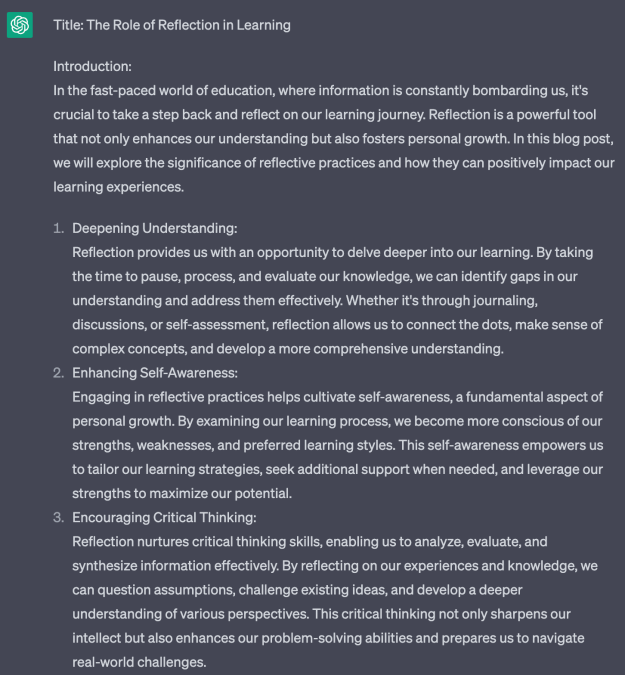
Would I ever just use Chat GPT to write my Daily Ink? No. But would I use it as a launching pad to help me generate ideas, or help me write a first draft? Absolutely. However, that’s just me. What you see above will be the kind of thing people who generate daily posts as part of a paid gig will do regularly. Sure they will make it sound a bit less formal, a bit more natural or conversational… but there are actually other Artificial Intelligences (yes plural, AI is not a single thing) which will do this and make it undetectable should you ask an AI detector if a human wrote it. Need something longer, like a school essay? Just ask Chat GPT to expand each of the 5 points into full paragraphs.

I didn’t iterate. I didn’t ask a more detailed question. I didn’t ask Chat GPT to further develop the ideas… If I did, it would make the above results even better and it would do so in a matter of seconds. And educators, try as you might, you can’t police it.

We are not far away from finding more AI written (or AI assisted) content on the internet than just purely human generated content… and we won’t know the difference.

— — — — — — — — — — — — — — — — — 

Update: (…I came back to this a few hours later.)

TLDR: The question isn’t how good is the AI tool, the question is, “How good are my prompts?”

I followed up and requested Chap GPT to, “Write the above blog post in a more conversational manner, using paragraphs without numbering or section titles.”
Here is the updated version:

The Role of Reflection in Learning

In the fast-paced world of education, where we’re constantly bombarded with information, it’s important to take a step back and reflect on our learning journey. Reflection is a powerful tool that not only enhances our understanding but also fosters personal growth. So, let’s dive into the significance of reflective practices and how they can positively impact our learning experiences.

When we engage in reflection, we go beyond surface-level learning. It provides us with an opportunity to delve deeper into our knowledge and identify any gaps in our understanding. By pausing, processing, and evaluating what we’ve learned, we can connect the dots and develop a more comprehensive understanding of the subject matter. Whether it’s through journaling, discussions, or self-assessment, reflection allows us to make sense of complex concepts and strengthen our grasp on the material.

But reflection goes beyond academic understanding. It also enhances our self-awareness, which is a crucial aspect of personal growth. By reflecting on our learning process, we become more conscious of our strengths, weaknesses, and preferred learning styles. This self-awareness empowers us to tailor our learning strategies, seek additional support when needed, and leverage our strengths to maximize our potential. It’s like having a roadmap that guides us towards effective learning.

Another great benefit of reflection is its ability to foster critical thinking skills. When we reflect, we engage in thoughtful analysis, evaluation, and synthesis of information. We question assumptions, challenge existing ideas, and gain a deeper understanding of various perspectives. This critical thinking not only sharpens our intellect but also enhances our problem-solving abilities. It equips us with the skills needed to tackle real-world challenges with confidence and creativity.

Reflection is also a catalyst for continuous improvement. Learning is a lifelong journey, and reflection plays a vital role in our growth. By reflecting on our successes and failures, we can identify areas for improvement and set meaningful goals. Regular self-reflection allows us to track our progress, celebrate achievements, and make necessary adjustments to our learning strategies. It promotes a growth mindset, inspiring us to embrace challenges, persist through obstacles, and strive for excellence.

In addition to all these benefits, reflection fosters metacognition, which is our ability to think about our own thinking. When we engage in metacognitive practices, such as reflecting on our learning process, monitoring our comprehension, and evaluating our strategies, we become more self-regulated learners. This metacognitive awareness empowers us to take control of our learning, adapt our approaches, and become more efficient and effective learners overall.

So, let’s make a conscious effort to pause, reflect, and embark on a transformative learning journey filled with growth, insight, and personal development. By embracing reflective practices, we deepen our understanding, foster self-awareness, sharpen critical thinking skills, promote continuous improvement, and cultivate metacognitive abilities. It’s time to unlock the true potential of our learning experiences through the power of reflection.

Then I followed up with, “Try again, still more conversational and less like an essay. Vary sentence and paragraph length, and end with a thought provoking question.”

I didn’t like what it came up with so I followed up one more time with, “This last version is a bit too conversational, try again and this time don’t start sentences with coordinating conjunctions like ‘But’ and ‘So’. Also change the first sentence so it less formal.”

Reflection in Learning: Unleashing the Power Within

In the whirlwind of education, where information bombards us from all directions, it’s easy to overlook the importance of reflection in our learning journey. We often rush from one lesson to the next, absorbing knowledge without truly digesting it. But what if we hit the pause button and took a moment to reflect?

Reflection goes beyond simply memorizing facts and figures. It’s a transformative process that allows us to delve deeper into our thoughts, experiences, and understanding of the subjects we encounter. It’s like shining a spotlight on our minds and examining everything we’ve absorbed in a more meaningful way.

What’s truly remarkable about reflection is that it extends beyond academia. It plays a crucial role in our personal growth as well. By engaging in reflection, we become more aware of our strengths, weaknesses, and unique learning styles. It’s like getting to know ourselves as learners on a whole new level. This self-awareness empowers us to tailor our learning strategies and leverage our strengths to maximize our potential.

Reflection isn’t a passive exercise; it’s an active one that fuels critical thinking. When we reflect, we question assumptions, evaluate information, and connect the dots. It enables us to go beyond the surface-level understanding and dive into the deeper layers of knowledge. This kind of thinking not only expands our intellectual capacity but also equips us with the skills to tackle real-world challenges with confidence and creativity.

Yet, the power of reflection doesn’t stop there. It serves as a catalyst for growth and continuous improvement. When we take the time to reflect on our learning journey, we identify areas where we can enhance our skills and knowledge. We set meaningful goals and work diligently towards them. It’s like having a personal roadmap for our own development, guiding us towards excellence and progress.

Intriguingly, reflection is also about metacognition – thinking about our own thinking. By engaging in metacognitive practices, such as reflecting on our learning process or evaluating our strategies, we become self-regulated learners. We take charge of our learning experience, adapt our approaches, and become more efficient and effective learners overall. It’s like having an internal compass that helps us navigate the vast landscape of knowledge.

So, let’s embrace the power of reflection. Let’s pause, process, and ponder on what we’ve learned. When we do, we unlock the true potential of our learning experiences. We deepen our understanding, foster self-awareness, sharpen critical thinking skills, and pave the way for continuous growth and personal transformation.

Have you taken a moment to reflect on your learning journey lately? What insights have you gained? How has reflection impacted your personal growth? Share your valuable thoughts and experiences in the comments below.

I think it would take one final personal edit, tweaking as I read it over once, and I’d have a pretty good blog post that’s both insightful and hard to identify as AI generated.

The question isn’t how good is the AI tool, the question is, “How good are my prompts?”

The secret sauce of iHub – Time and Space, and Pace

Inquiry Hub (iHub) is a small school that runs more like a specialty program than a school. The backbone of the program (besides some awesome and innovative educators) is two courses we wrote: Foundations of Inquiry 10 – BAA Course 2018 &  & Foundations of Inquiry 11 – BAA Course 2018. Large high schools have a multitude of elective offerings that students can take, and we can’t offer them with our small teaching staff. Instead, Grades 9 & 10 take these two courses and then in Grades 11 & 12 students do IDS, Independent Directed Studies, where they develop their own year-long course.

Here  is a student, Thia, describing her inquiries, her ‘electives’, at our school:

You can see other unique projects on our student page.

I’ve been doing some reflection and our inquiry courses are necessary, but they not the secret sauce of our school. The secret sauce has two main ingredients: ‘Time and Space’ and ‘Pace’.

  1. We create the time and space for students to work on projects that they want to work on. Student are not ‘in front’ of a teacher who is ‘in front’ of the room all day. They have time and space to work independently and in groups. We create multidisciplinary projects and use an adapted version of scrum project management to get required content out of the way so that students have more time to work on projects they want to work on. They get the time and space to follow their passions and interests while at school.
  2. We provide support for students to help them maintain a good pace. The most important trait a student needs to be successful at our school is that they are self-directed learners… they know how to use their time well. However, most Grade 8 students don’t come fully pre-loaded with these skills, (in fact many adults lack these skills). So, teachers work as a team and our student services teacher connects with any students that are behind on work. She works with students to help them build in strategies that help them keep up and stay on top of work. This is essential in a school where students can have up to 50% of their school day without a teacher in front of them, directing their work/tasks.

Yes, the inquiry process is important. Yes, we can talk about their mindset and look at how we examine failure, but when I really think about what makes Inquiry Hub tick (again, besides the hard work of great teachers) I think that giving students the time and space to explore their interests while supporting them in keeping up a good pace, is what the school is really all about.

Un-breaking a break in routines

Yes, I went back home to my parents house after my father’s death, and spent no time alone except sleep and going to the bathroom.

Yes, I’m dealing with a herniated disc and choosing between feeling loopy on drugs or in pain.

Yes, I also fell and it took weeks for my knee to heal because the wound would re-open every time I bent my knee.

Yes, I’ve missed a few days posting here in the last few weeks. I’ve also had the least amount of exercise since I started tracking in January 2019. I’ve also missed more meditations than I have in that same time.

Yes, I’ve missed more work in the past month than I’ve missed in any 10 years of working combined.

Yes, I’m further behind in email than I ever have been… (I’m smart enough not to try to be on email when loopy or in pain).

Yes, I’m really hard on myself when I can’t do the things I think I should be doing.

But I also know how important these routines are for my mental health. It’s 10:45am and I’m finally out of bed and the loopy feeling of the drugs have worn off enough that while I’m not in pain, I feel that I can sit here and write this. I also feel like it’s not safe to walk on a treadmill, like I did for the first time in weeks last night before taking my meds for bed. Sitting in bed this morning I realized that I can lie on the floor and do some stretching. I can definitely meditate. I can listen to my body and go for walks outside, rather than navigating a treadmill.

I can’t rebuild the routines I had before all this just yet, but I can build new routines that keep me thinking positively rather than lying on my back with a pillow below my knees for most of the day. Well, actually that might still be a big part of my coming week, but at least I can (re)build i some routines that make me feel better both physically and mentally.

I’ve said it before and I’ll say it again… I have tremendous sympathy for anyone who lives with chronic pain. It inspires me to see people who deal with daily or constant pain and still live out their daily lives. For now, I just need to build in some routines that make me feel more human.

I need to un-break my break in routines… not trying to do what I did before… not trying to do too much and setting myself back. Just trying to build a new routine that lets me feel good. On that note, my neck and shoulder have told me that this is enough sitting and typing for a few hours, if not the rest of the day. I’m going to go lay on the floor, listen to some music, stretch and meditate. The best time to start a new habit is right now!