Author Archives: David Truss

Playing with Chat GPT

Yesterday I asked Chat GPT for blog post ideas for a blog that discusses ‘education, learning, and general life lessons‘. This is what it responded with:

I then chose #4 and asked: Write a short blog post titled, “The Role of Reflection in Learning” on the topic of Exploring the significance of reflective practices in enhancing learning and personal growth.

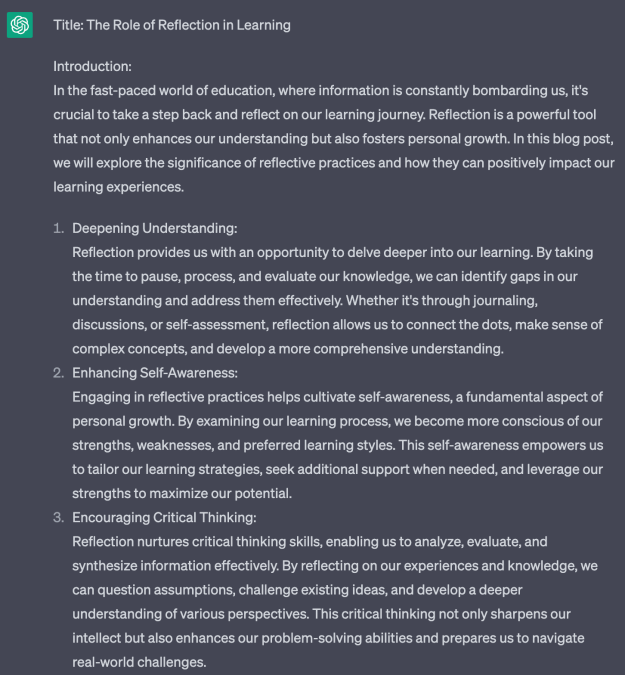
This is what Chat GPT came up with:

Would I ever just use Chat GPT to write my Daily Ink? No. But would I use it as a launching pad to help me generate ideas, or help me write a first draft? Absolutely. However, that’s just me. What you see above will be the kind of thing people who generate daily posts as part of a paid gig will do regularly. Sure they will make it sound a bit less formal, a bit more natural or conversational… but there are actually other Artificial Intelligences (yes plural, AI is not a single thing) which will do this and make it undetectable should you ask an AI detector if a human wrote it. Need something longer, like a school essay? Just ask Chat GPT to expand each of the 5 points into full paragraphs.

I didn’t iterate. I didn’t ask a more detailed question. I didn’t ask Chat GPT to further develop the ideas… If I did, it would make the above results even better and it would do so in a matter of seconds. And educators, try as you might, you can’t police it.

We are not far away from finding more AI written (or AI assisted) content on the internet than just purely human generated content… and we won’t know the difference.

— — — — — — — — — — — — — — — — — 

Update: (…I came back to this a few hours later.)

TLDR: The question isn’t how good is the AI tool, the question is, “How good are my prompts?”

I followed up and requested Chap GPT to, “Write the above blog post in a more conversational manner, using paragraphs without numbering or section titles.”
Here is the updated version:

The Role of Reflection in Learning

In the fast-paced world of education, where we’re constantly bombarded with information, it’s important to take a step back and reflect on our learning journey. Reflection is a powerful tool that not only enhances our understanding but also fosters personal growth. So, let’s dive into the significance of reflective practices and how they can positively impact our learning experiences.

When we engage in reflection, we go beyond surface-level learning. It provides us with an opportunity to delve deeper into our knowledge and identify any gaps in our understanding. By pausing, processing, and evaluating what we’ve learned, we can connect the dots and develop a more comprehensive understanding of the subject matter. Whether it’s through journaling, discussions, or self-assessment, reflection allows us to make sense of complex concepts and strengthen our grasp on the material.

But reflection goes beyond academic understanding. It also enhances our self-awareness, which is a crucial aspect of personal growth. By reflecting on our learning process, we become more conscious of our strengths, weaknesses, and preferred learning styles. This self-awareness empowers us to tailor our learning strategies, seek additional support when needed, and leverage our strengths to maximize our potential. It’s like having a roadmap that guides us towards effective learning.

Another great benefit of reflection is its ability to foster critical thinking skills. When we reflect, we engage in thoughtful analysis, evaluation, and synthesis of information. We question assumptions, challenge existing ideas, and gain a deeper understanding of various perspectives. This critical thinking not only sharpens our intellect but also enhances our problem-solving abilities. It equips us with the skills needed to tackle real-world challenges with confidence and creativity.

Reflection is also a catalyst for continuous improvement. Learning is a lifelong journey, and reflection plays a vital role in our growth. By reflecting on our successes and failures, we can identify areas for improvement and set meaningful goals. Regular self-reflection allows us to track our progress, celebrate achievements, and make necessary adjustments to our learning strategies. It promotes a growth mindset, inspiring us to embrace challenges, persist through obstacles, and strive for excellence.

In addition to all these benefits, reflection fosters metacognition, which is our ability to think about our own thinking. When we engage in metacognitive practices, such as reflecting on our learning process, monitoring our comprehension, and evaluating our strategies, we become more self-regulated learners. This metacognitive awareness empowers us to take control of our learning, adapt our approaches, and become more efficient and effective learners overall.

So, let’s make a conscious effort to pause, reflect, and embark on a transformative learning journey filled with growth, insight, and personal development. By embracing reflective practices, we deepen our understanding, foster self-awareness, sharpen critical thinking skills, promote continuous improvement, and cultivate metacognitive abilities. It’s time to unlock the true potential of our learning experiences through the power of reflection.

Then I followed up with, “Try again, still more conversational and less like an essay. Vary sentence and paragraph length, and end with a thought provoking question.”

I didn’t like what it came up with so I followed up one more time with, “This last version is a bit too conversational, try again and this time don’t start sentences with coordinating conjunctions like ‘But’ and ‘So’. Also change the first sentence so it less formal.”

Reflection in Learning: Unleashing the Power Within

In the whirlwind of education, where information bombards us from all directions, it’s easy to overlook the importance of reflection in our learning journey. We often rush from one lesson to the next, absorbing knowledge without truly digesting it. But what if we hit the pause button and took a moment to reflect?

Reflection goes beyond simply memorizing facts and figures. It’s a transformative process that allows us to delve deeper into our thoughts, experiences, and understanding of the subjects we encounter. It’s like shining a spotlight on our minds and examining everything we’ve absorbed in a more meaningful way.

What’s truly remarkable about reflection is that it extends beyond academia. It plays a crucial role in our personal growth as well. By engaging in reflection, we become more aware of our strengths, weaknesses, and unique learning styles. It’s like getting to know ourselves as learners on a whole new level. This self-awareness empowers us to tailor our learning strategies and leverage our strengths to maximize our potential.

Reflection isn’t a passive exercise; it’s an active one that fuels critical thinking. When we reflect, we question assumptions, evaluate information, and connect the dots. It enables us to go beyond the surface-level understanding and dive into the deeper layers of knowledge. This kind of thinking not only expands our intellectual capacity but also equips us with the skills to tackle real-world challenges with confidence and creativity.

Yet, the power of reflection doesn’t stop there. It serves as a catalyst for growth and continuous improvement. When we take the time to reflect on our learning journey, we identify areas where we can enhance our skills and knowledge. We set meaningful goals and work diligently towards them. It’s like having a personal roadmap for our own development, guiding us towards excellence and progress.

Intriguingly, reflection is also about metacognition – thinking about our own thinking. By engaging in metacognitive practices, such as reflecting on our learning process or evaluating our strategies, we become self-regulated learners. We take charge of our learning experience, adapt our approaches, and become more efficient and effective learners overall. It’s like having an internal compass that helps us navigate the vast landscape of knowledge.

So, let’s embrace the power of reflection. Let’s pause, process, and ponder on what we’ve learned. When we do, we unlock the true potential of our learning experiences. We deepen our understanding, foster self-awareness, sharpen critical thinking skills, and pave the way for continuous growth and personal transformation.

Have you taken a moment to reflect on your learning journey lately? What insights have you gained? How has reflection impacted your personal growth? Share your valuable thoughts and experiences in the comments below.

I think it would take one final personal edit, tweaking as I read it over once, and I’d have a pretty good blog post that’s both insightful and hard to identify as AI generated.

The question isn’t how good is the AI tool, the question is, “How good are my prompts?”

The secret sauce of iHub – Time and Space, and Pace

Inquiry Hub (iHub) is a small school that runs more like a specialty program than a school. The backbone of the program (besides some awesome and innovative educators) is two courses we wrote: Foundations of Inquiry 10 – BAA Course 2018 &  & Foundations of Inquiry 11 – BAA Course 2018. Large high schools have a multitude of elective offerings that students can take, and we can’t offer them with our small teaching staff. Instead, Grades 9 & 10 take these two courses and then in Grades 11 & 12 students do IDS, Independent Directed Studies, where they develop their own year-long course.

Here  is a student, Thia, describing her inquiries, her ‘electives’, at our school:

You can see other unique projects on our student page.

I’ve been doing some reflection and our inquiry courses are necessary, but they not the secret sauce of our school. The secret sauce has two main ingredients: ‘Time and Space’ and ‘Pace’.

  1. We create the time and space for students to work on projects that they want to work on. Student are not ‘in front’ of a teacher who is ‘in front’ of the room all day. They have time and space to work independently and in groups. We create multidisciplinary projects and use an adapted version of scrum project management to get required content out of the way so that students have more time to work on projects they want to work on. They get the time and space to follow their passions and interests while at school.
  2. We provide support for students to help them maintain a good pace. The most important trait a student needs to be successful at our school is that they are self-directed learners… they know how to use their time well. However, most Grade 8 students don’t come fully pre-loaded with these skills, (in fact many adults lack these skills). So, teachers work as a team and our student services teacher connects with any students that are behind on work. She works with students to help them build in strategies that help them keep up and stay on top of work. This is essential in a school where students can have up to 50% of their school day without a teacher in front of them, directing their work/tasks.

Yes, the inquiry process is important. Yes, we can talk about their mindset and look at how we examine failure, but when I really think about what makes Inquiry Hub tick (again, besides the hard work of great teachers) I think that giving students the time and space to explore their interests while supporting them in keeping up a good pace, is what the school is really all about.

Un-breaking a break in routines

Yes, I went back home to my parents house after my father’s death, and spent no time alone except sleep and going to the bathroom.

Yes, I’m dealing with a herniated disc and choosing between feeling loopy on drugs or in pain.

Yes, I also fell and it took weeks for my knee to heal because the wound would re-open every time I bent my knee.

Yes, I’ve missed a few days posting here in the last few weeks. I’ve also had the least amount of exercise since I started tracking in January 2019. I’ve also missed more meditations than I have in that same time.

Yes, I’ve missed more work in the past month than I’ve missed in any 10 years of working combined.

Yes, I’m further behind in email than I ever have been… (I’m smart enough not to try to be on email when loopy or in pain).

Yes, I’m really hard on myself when I can’t do the things I think I should be doing.

But I also know how important these routines are for my mental health. It’s 10:45am and I’m finally out of bed and the loopy feeling of the drugs have worn off enough that while I’m not in pain, I feel that I can sit here and write this. I also feel like it’s not safe to walk on a treadmill, like I did for the first time in weeks last night before taking my meds for bed. Sitting in bed this morning I realized that I can lie on the floor and do some stretching. I can definitely meditate. I can listen to my body and go for walks outside, rather than navigating a treadmill.

I can’t rebuild the routines I had before all this just yet, but I can build new routines that keep me thinking positively rather than lying on my back with a pillow below my knees for most of the day. Well, actually that might still be a big part of my coming week, but at least I can (re)build i some routines that make me feel better both physically and mentally.

I’ve said it before and I’ll say it again… I have tremendous sympathy for anyone who lives with chronic pain. It inspires me to see people who deal with daily or constant pain and still live out their daily lives. For now, I just need to build in some routines that make me feel more human.

I need to un-break my break in routines… not trying to do what I did before… not trying to do too much and setting myself back. Just trying to build a new routine that lets me feel good. On that note, my neck and shoulder have told me that this is enough sitting and typing for a few hours, if not the rest of the day. I’m going to go lay on the floor, listen to some music, stretch and meditate. The best time to start a new habit is right now!

Keeper of your digital history

When I lived in China, I had a hard time communicating on any social media. I connected to this blog using Posterous, which let me post easily from an App on my phone, before WordPress had an App. When Posterous went defunct all the images I posted through their App were not saved on WordPress and so those images were lost. So I have old posts like this, where I only have a dead link where a photo used to be:

This isn’t the only social media company that has gone defunct, taking the history of my work with it. I loved using the Ning Network communites like Classroom 2.0, I had a student project with over a 100,000 visits on Wikispaces, this video had close to 100,000 views on BlipTV, and I had great conversations archived on coComment. My original blog was on ELGG, where I had a great community of bloggers to learn from, then it switched to Eduspaces which was less friendly and forced me to do the smart thing and self-host on DavidTruss.com. Delicious, Diigo, and Scribed were communities but now they’ve changed and are just ‘places’ that I used to visit and use. And there are plenty of other tools that have come and gone and when they are gone, so is a record of everything I did in those spaces.

One social media tool that I have used more than any other is Twitter. I was such a fan, I even wrote an ebook about how to get started on Twitter, then gave it away for free. I have Tweeted 33,800+ times since I started Twitter in 2007. Today I decided to request an archive of all my tweets.

I’ve lost too many great conversations and archives of data because of social media services either transforming to something different, suddenly requiring fees that are beyond what I’m willing to pay, or just going defunct… and with so much happening to Twitter right now, I just figured I’d request my data and store it myself for safe keeping. If anything happens to Twitter, I want a record of what I did in this social media space. I’m not predicting that Twitter will go the way of the dodo bird, but I’m just not confident it will look the same at the end of 2023, now that it is privately owned and operated. I want a backup of my data… just in case.

Shifting Paradigms

TLDR: I’m not publishing any more posts on my Pair-a-Dimes blog (where this post is being cross-posted)… I’d be honoured if my Pair-a-Dimes subscribers, (and/or you), subscribed here on Daily Ink. To do so, fill in your email on the subscription form on the right-side column on your computer, or under the comment box on your mobile device.

Well, if it isn’t obvious yet, I will make it clear now. After whimsically naming my blog ‘Pair-a-Dimes for Your Thoughts‘ on a blog service called Elgg, and publishing my first post on March 29th, 2006 (reposted on DavidTruss.com on March 26th, 2008), it is now evident to me that I’ve fully transitioned to my Daily-Ink blog. My last post on Pair-a-Dimes (Choice time for teacher Pro-D) before this one was over a year ago. The one before that (How do we get to ‘YES’?) was written almost two years ago. Meanwhile, on my Daily-Ink I’ve posted every day since July 6th, 2019 (It’s time…). That’s 3 days short of 3 years, or 1,093 daily blog posts.

To put that number in perspective, I had my Pair-a-Dimes blog for 16 years and I only blogged 356 times… less than what I did in my first year blogging daily. That said, Pair-a-Dimes was much longer in format, and much more focussed on education. And although I still write about education and learning on Daily-Ink, I will miss the educational focus of Pair-a-Dimes with the tagline, “Reflections on Education, Technology and Learning“. But committing to blogging daily, and adding more to another blog is too much for me… especially as I think about reviving my podcasts this summer, after an almost 2 year hiatus.

I absolutely loved the community I built around Pair-a-Dimes. This blog is the reason I got to present both for Alan November, and with his team. This blog got me connected to Connected Principals, a now defunct site where principals shared their learning (these are the posts I also shared there). This blog became a learning space for me.


This blog is where I learned to do html, it’s where I learned about wikis, it’s what inspired me to blog with students. It helped me become a better educator and a more reflective leader.

I may come back here to post again, but it’s unlikely. However, because I host both blogs on DavidTruss.com, this blog will stay up for as long as I choose to keep blogging or keep my personal website, so it’s not going anywhere… it’s also not going to be updated.

I realize that I have a significant number of email subscribers to Pair-a-Dimes who might enjoy getting 1-3 minute daily reads via email. If that’s you, I’m truly honoured. On your computer you’ll find the subscribe button on the right hand side column, near the top of this page. If you are on mobile, scroll down below the comment section to find the subscribe button. I’m going to try to transfer over the WordPress subscribers, (whom I don’t have an email address for), but I won’t send an email to the 450 people still subscribed to Pair-a-Dimes on Feedburner after all these years. Instead, I’ll post this and hopefully anyone reading via email will subscribe to Daily-Ink. Whether you choose to transfer or not, I want to thank you as a reader of my Pair-a-Dimes. Whether you read posts dating back to 2006, or if you found one post that made you subscribe, you helped inspire me to keep writing. Thank you for being one of over 370,000 Pair-a-Dimes visitors since I moved to DavidTruss.com, I’m honoured that you joined me, that you took the time to read, comment, inspire me, and contribute to my learning.

The blogging adventures continue here on my Daily-Ink.

Doing something special

I don’t know how to write this without sounding like it’s bragging, so I’m just going to say it… We run an awesome little school.

It’s not perfect. We have a lot to improve still, but in 10 years we’ve had 10 iterations, tweaking and improving each year. Yes, covid was challenging to deal with but the changes to the way we integrate courses and have students do SCRUM project management have been pretty amazing these past couple years. Student inquiries and their ability to present and make incredible visuals to present with have levelled up considerably. We keep getting better and we are all excited about more updates to our program next year.

So when we finish off a year and our staff get letters and emails like these, it feels pretty good:

There are no words to convey how much we have appreciated all your efforts. Reinventing high school is no small thing. We have had highs and lows but the skills my kids are learning are going to serve them well in college and life. Thank you.

And:

Hi! I’m sure you already know this, but as another school year ends I still feel the need to say what an amazing, life-giving, and nurturing place IHub is and to express my deep thankfulness to everyone who works so hard to make IHub what it is! You’re not simply saving some students from being chewed up and spit out in pieces by a more traditional high school experience for which they are not well suited, you are opening doors that would have been invisible, facilitating adventures of self-discovery that would have been impossible and changing futures. Deep thanks to all of you!!!!!

And this from a excellent student who would be successful no matter where they attended school:

Thank you for a wonderful first year at ihub! I can now say firsthand what an amazing school this is and how it is a perfect fit for me!

Sometimes I end the year dissatisfied that we, that I, didn’t do more. Wishing I’d somehow given more of myself, and contributed more to our students and our community. This year these notes hit me at the right time. I realize that we are doing something special, and while I know there’s more to do, I will head into summer holidays in a couple weeks feeling great about what we’ve been doing and what’s still to come.

Missing the point

“The meaning of your communication is the response that you get.”

This is a quote I heard in a communication course that I took in my early 20’s, more than a half of my life ago… but I remember it and it is a bit of a mantra for me. So, when I share something and the message isn’t clear, I recognize that I need to take at least partial responsibility. An unexpected response tells me that my communication was not clear enough to get the response I expected.

Yesterday I was mad. I actually expected a shooting like the one in a Texas school to happen. I didn’t know it would be a school, but I saw the publicity the supermarket shooting in Buffalo the week before got and I figured another high profile shooting was coming. When it happened, and when it was a school, I was angry. That anger came through in my post, Enough is enough. But writing it wasn’t enough for me. I don’t pretend I have an audience big enough to make a genuine difference. So, I sent it to some local and some US reporters that I have access to via Twitter. It only went to accounts that allow Direct Messages, so that I was sending the messages privately.

One reporter responded. I won’t name him, because I have a lot of respect for him and I appreciate him responding to me… he was the only one. These were his words:

David, I don’t agree with you one bit. The rate of mass shootings in Canada (and MANY other countries) versus the US is so vastly different, with practically no difference in the way media treats the subject. That in itself is evidence of a flaw in your logic. I am in the businesses of shedding light on the issues that erode our safety and security because ignoring a problem never makes it go away. Do I wish these events never happened? Am I heartbroken and traumatized by what I see and hear and have to filter for our audience? You’re damn right I am. I hate every minute of it. But am I to blame? Not at all. Why don’t you direct some of your energy at those who refuse to put restrictions on killing machines and those who pull the trigger?

And this was my response:

I’m only saying don’t report their names. Don’t highlight their lives. Yes this is a US problem, I’ve mostly sent this to US news. But how hard would it be not to dignify the killers. To remove any mention of their identity? The stats tell us these are more likely to happen after a high publicity act. The people doing the copycat act know they will be (in)famous like the other killers before them. I know gun laws in the US are a big problem… but that doesn’t diminish the fact that all news outlets are making it worse. Apologies if you think I’m blaming you, I’m not. I’m blaming a news system that glorifies killers. That’s the part I am struggling with. Stop naming the killers. Stop highlighting their lives. That’s my point. It’s not about you, it’s about this:

That is the part media outlets play. And all of them can do better.

He took it as a personal attack, and he missed the point. I blame myself. I should have written a plea, not a condemnation. The irony to me is this line he shared, “I am in the businesses of shedding light on the issues that erode our safety and security because ignoring a problem never makes it go away.” The simple fact is that by glorifying the killer, he and his colleagues are eroding our safety and security. They are publicizing to the weak and the disturbed that they too can become famous.

Am I heartbroken and traumatized by what I see and hear and have to filter for our audience?” He said. Yes, filtering for the audience is part of being a news reporter, and what I’m asking is for him and his colleagues to filter out the names of the idiots with guns. I’m not saying, ‘Don’t report the news.’ I’m not saying, ‘You are responsible.’ I am saying that highlighting and profiling the idiots with guns erodes public safety and security. How hard would it be for news media to have a simple code of conduct:

  • Do not mention a mass shooter’s name.
  • Do not share images of them.
  • Do not investigate their lives, profile them, or quote them.

That’s what I wanted to say. But that’s not what I communicated. I can’t blame anyone for missing the point, when I failed to make the point clear.

Spam and the end of my contact form

I’ve had a contact form on my blog since 2007. For the last few years, this has only been used to spam me: ‘Improve your SEO’; ‘I notice the content of this page and think you’d like to backlink to us… we’ll pay you’; ‘Would you like to become a distributor for…’; and even; ‘I’m horny’ with a link to some porn, dating, or mail order bride site. I can’t remember the last time someone used it to actually contact me for any legitimate reason.

Instead of deleting my contact page, I just deleted the contact form, and the first line on the page is:

Would you like to contact me? Great! I’m @datruss on Twitter. You can also leave a comment on my daily blog, “Daily-Ink“.

Hopefully I don’t drive spammers to my blog, in which case I’ll have to change that too. It’s a shame that there is so much spam that I need to do this. I’ve read that as much as 85% of all email is spam. I think responses to contact forms would be much higher than that.

I wish there was a way to spam spammers such that their job became unmanageable. Instead of them filling our inboxes with a waste of time and energy, we should figure out a way to send them ‘smart’ spam back. If they want a back link from my site, they get hundreds of responses from hundreds of fake email addresses saying, ‘Yes I’ll add a back link to your blog’ and linking to other spammer’s websites and fake PayPal accounts. Drown them in so many fake but positive responses that they can’t determine what’s worth pursuing and what’s not.

Spam the spammers.

Without a definitive attack on their livelihood, they don’t have an incentive to stop.

But for now, they win… no more contact form from me. Fortunately, I’m pretty easy to get a hold of on social media and here on my Daily-Ink, and so while removing my contact form won’t affect people’s ability to connect with me, it will reduce how much spam comes my way.

A place for everything

There is a saying, “A place for everything and everything in its place.”

Right now that’s not the case in our household. We are moving back onto our main floor after an extensive renovation, and now we have to find a place for everything. When it comes to the kitchen, that’s a real challenge. Our new fridge doesn’t seem as big as our old one, and the shelve sizes don’t seem to work for us. Our new cupboards and drawers are slowing becoming the place where we keep things, but I still find myself going on scavenger hunts to find things I usually find easily.

The good news, I absolutely love the new look. We took out the walls between our living room, dining room and kitchen and have a fully open concept. It looks awesome, and it already feels like home. But for now, we still have a lot of things to put away, and while we might find spots for everything, remembering where everything is kept will take a some time.

The Great One

I went to the game for a single purpose… to prove to myself that Wayne Gretzky was the most overrated player. I left thinking he was a hockey god.

I lived in Toronto and was a fan of the Maple Leafs. I was a diehard fan, believing that one day I’d see them win the Stanley Cup, despite the fact that they haven’t won one since my birth year, 1967. But every hear I expected them to win. They didn’t.

As a huge Maple Leaf fan back then, I wasn’t a fan of Wayne Gretzky and the Edmonton Oilers. And in fact, I was sure that the hype around Gretzky was just that, hype. He was surrounded by a great team and they helped him shine. I was sure of this, until I saw him play. I paid the most I’d ever paid for hockey tickets and sat 2 rows behind the Leaf bench. After years of sitting in the nosebleed level ‘Grey’ seats, I felt I was right in on the action.

If I remember the game correctly, the Oilers beat the Leafs 9-6, and Gretzky got 6 points. But the reality is that he should have gotten 12. He was amazing. Every time he was on the ice it felt like something exciting was going to happen. Here are three examples I can remember:

1. Behind the Leaf net: Before Gretzky, behind the net was where defenders took the puck, no office ever chose to intentionally take the puck back there, but Gretzky did. And when he did he controlled both teams. He froze the defence, unsure of where he was going or where he was passing next. Watching him control the game from behind the net was a sight to see.

2. The boards: Gretzky wasn’t a big guy compared to many other players, but when he went against the boards, he owned the puck. I can remember two specific times he went into the boards with other players fighting for the puck, then the puck would come flying out and land on an Oiler teammate’s stick. I was close enough to see the surprise on their faces. I watched as they shot on half empty nets, the goalie equally as shocked to see the puck shoot across to the other side of the ice. When this happened a second time I realized, if there was another Gretzky on the team, that would have been a goal… he wasn’t rising to the level of play of his team, he fully surpassed them.

3. Defence: He disrupted so many plays on defence. When the puck was dumped into the blue line he got to the puck on the boards first, knowing where to be, and then there would be a pass and the play was going the other way. In one amazing move a favourite defender of mine, Leaf’s number 9, Stuart Gavin, was taking the puck out of the Leaf’s zone and he skated towards the Leaf’s blue line. I was watching Gretzky on the other side of the ice, also near the blue line. For no apparent reason he skated in a circle, spinning tightly. Then he sped in behind Stuart, lifted his stick, and went in for a breakaway goal. I felt close enough to say, ‘look out’ but I was too surprised to do so.

It took me a while to realize what Gretzky’s little spin did. First of all, if he skated directly to Stuart without the spin, he would have been in Stuart’s line of sight and would not have surprised him from behind. Secondly, if he had paused rather than spun, he would not have had the momentum to catch him. An absolutely brilliant little move on the opposite side of the blue line away from the play, that led to a breakaway goal.

I went into the game thinking I was there to debunk an overrated player and I left with the conviction that he truly was The Great One, and I felt honoured to have watched him play live.