Tag Archives: future

It’s going to be messy

“Technology is a way of organizing the universe so that man doesn’t have to experience it” ~ Max Frisch

One of my favourite presentations I’ve ever created was back in 2008 for Alan November’s BLC – ‘Building Leadership Capacity’ conference. It was called: The Rant, I Can’t, The Elephant and the Ant, and it was about embracing new technology, specifically smartphones in schools.

The rant was about how every new technology is going to undermine education in a negative way, starting with the ball point pen.

I can’t was about the frustrations educators have with learning to use new tools.

The elephant was the smartphone, it was this incredibly powerful new tool that was in the room. You can’t ignore an elephant in the room.

The Ant was a metaphor for networking and learning from others… using a learning community to help you with the transformation of your classroom.

I ended this with a music slideshow that I later converted to video called, Brave New World Wide Web. This went a bit viral on BlipTV, a now defunct rival of YouTube.

The next year I presented at the conference again and my favourite of my two presentations was, The POD’s are Coming, about Personally Owned Devices… essentially laptops and tablets being brought into schools by students. These may be ubiquitous now, but it was still pretty novel in 2009.

These two presentations and video give a pretty strong message around embracing new technology in schools. So my next message about embracing AI tools like Chat GPT in schools is going to come across fairly negatively:

It’s going to be a bumpy and messy ride.

There is not going to be any easy transition. It’s not just about embracing a new technology, it’s about managing the disruption… And it’s not going to be managed well. I already had an issue in my school where a teacher used Chat GPT to verify if AI wrote an assignment for students. However Chat GPT is not a good AI checker and it turned out to be wrong for a few students who insisted they wrote the work themselves, and several AI detectors agreed. But this was only checked after the students were accused of cheating. Messy.

Some teachers are now expecting students to write in-class essays with paper and pen to avoid students using AI tools. These are kids that have been using a laptop since elementary school. Messy.

Students are using prompts in Chat GPT that instruct the AI to write with language complexity based on their age. Or, they are putting AI written work into free paraphrasing tools that fool the AI detectors. Messy.

Teacher’s favourite assignments that usually get students to really stretch their skills are now done much faster and almost as good with AI tools. And even very bright students are using these tools frequently. While prompt generation is a good skill to have, AI takes the effort and the depth of understanding away from the learners. Messy.

That final point is the messiest. For many thoughtful and thought provoking assignments, AI can now decrease the effort to asking AI the right prompt. And while the answer may be far from perfect, AI will provide an answer that simplifies the response for the the learner. It will dumb down the question, or produce a response that makes the question easier.

Ai is not necessarily a problem solver, it’s a problem simplifier. But that reduces the critical thinking needed. It waters down the complexity of work required. It transforms the learning process into something easier, and less directly thoughtful. Everything is messier except the problem the teacher has created, which is just much simpler to complete.

Learning should be messy, but instead what’s getting messy is the ability to pose problems that inspire learning. Students need to experience the struggle of messy questions instead of seeking an intelligent agent to mess up the learning opportunities.

Just like any other tool, there are places to use AI in education and places to avoid using the tool. The challenge ahead is creating learning opportunities where it is obvious when the tool is and isn’t used. It’s having the tool in your tool box, but not using it for every job… and getting students to do the same.

And so no matter how I look at this, the path ahead is very messy.

Retirement horizon

Last night I went to our district principal’s retirement celebration. This was the first time I went to this yearly event while actually thinking about my own retirement on the horizon. I still have at least a few more years to go, but I have to say that seeing this event from the lens of my own retirement was a unique experience.

I don’t know what I’ll do with my time when I retire, but talking to the retired folk at last night’s celebration, not too many of them seem to feel they have more time on their hands than they know what to do with. I know I won’t fully retire, I will find some way to continue working, even if it’s just dedicating more time to writing.

What I do know is that I still see things I can do to make a difference in my current job, and looming retirement or not, I have a job to do and it takes effort to do it well. Still, it’s fun to dream about what the next adventure could hold, and I’m looking forward to that horizon a little more than I have in the past.

Use it or fall behind

Check out what Khan Academy has done so far, since getting early access to Chat GPT4 last August.

And here’s what’s coming soon:

The gut reaction to using new technology in education is to ban, block, and/or punish students for ‘cheating’. While I’m not going to link to the many times I’ve already said this, I’ll say it again… the technology is not going away!

So how do we use it effectively, creatively, and for learning? 

That is the question question to ask… and Chat GPT4 and tools like it probably have better answers than you can come up with.

Dinner with the dead

A question Tim Ferris used to regularly ask his podcast guests was, “If you could have dinner with one person, dead or alive, who would it be and why?”

Well now it might be a bit easier to have one of those dinner conversations… even if the person is dead.

Here’s a conversation on AI and education between Bill Gates and Socrates, but first the description of the video:

AI Brings Bill Gates & Socrates Together: A Must-Watch Dialogue on AI. An exclusive video of Bill Gates and ancient philosopher Socrates discussing the potential of artificial intelligence. Don’t miss this groundbreaking fusion of past wisdom and present innovation, reshaping our understanding of AI.

In this video, you will witness a fascinating discussion between Socrates, the Greek philosopher considered one of the greatest thinkers in history, and Bill Gates, the American entrepreneur and founder of Microsoft, one of the most important companies in the world of technology.

Despite belonging to different eras, Socrates and Gates have a lot in common. Both are considered pioneers in their respective fields and have had a significant impact on society.

The AI-generated conversation will allow these two great figures to discuss topics such as technology, ethics, education, and much more. Will Socrates and Bill Gates be able to find common ground in their ideas and thoughts? Find out in this video!

It didn’t need the laugh track, and there is a slight cartoonish feel to the two characters, but this technology is just getting better and better!

“How good are my AI prompts?”

Two thoughts about yesterday’s post, ‘Playing with Chat GPT‘:

1. I used the plural phrase ‘Artificial intelligences’ and followed up with, “yes plural, AI is not a single thing”. What’s both exciting and scary is that Chat GPT and other incredible AI tools are revolutionizing markets like health care diagnostics, manufacturing and logistics, coding, customer service and tech support, copy editing and content generation, audio and video editing, and even education. I think anyone who uses these tools can see why it’s exciting, but why do I also say scary? Here are two reasons:

First of all, many of these tools are open source or open access and/or very affordable for anyone to build on top of. This is great, but also permits people to do some pretty nefarious things, like produce deep fakes, and use these tools in increasingly evil ways. And as AI gets better, so does the ability to do greater harm.

Secondly, we are going to see a major decrease in jobs. Now this is under debate, with some people thinking there will just be a shift in jobs, but I disagree. For example, you own an online website that hires content 10 content writers to produce daily content to get new articles in front of your readers. You lay off 7 of them, keeping your best ones, and you have them use Chat GPT to write articles similar to the best, most popular ones on your site, and the 3 best remaining editors tweak the AI writing, make it better, easily doing the work of 10 writers. 

This kind of shift isn’t happening with just Chat GPT, there are more and more AI tools that are quickly shifting the need to less staff, who are more creative and innovative, to do jobs many more people did. If you are an elegant coder or excellent problem-solving tech support worker, your job is safe. If you are just competent at coding or tech support, an AI can and will do the job better than you, and you won’t be needed much longer. The irony is that your years of providing support will have helped train the very AI replacing you.

This isn’t just about Chat GPT, it’s about a plethora of Artificial Intelligences changing the way we learn, access information, get fooled, and work. And the pace of change will rival the any prior advancement in human history.

2. After publishing yesterday’s post, I went back to Chat GPT to play some more (as seen in the ‘Update’ at the bottom of the post). Three prompts after my original one I had something that was easy to read, and would take just one read-over and final edit to be something I could publish, which would be insightful, and difficult to know was AI generated. I ended my update with: The question isn’t how good is the AI tool, the question is, “How good are my prompts?”

…and if your prompts are not that good… just ask Chat GPT to improve them!

Here are a couple Twitter threads with some insightful prompts for Chat GPT.

Playing with Chat GPT

Yesterday I asked Chat GPT for blog post ideas for a blog that discusses ‘education, learning, and general life lessons‘. This is what it responded with:

I then chose #4 and asked: Write a short blog post titled, “The Role of Reflection in Learning” on the topic of Exploring the significance of reflective practices in enhancing learning and personal growth.

This is what Chat GPT came up with:
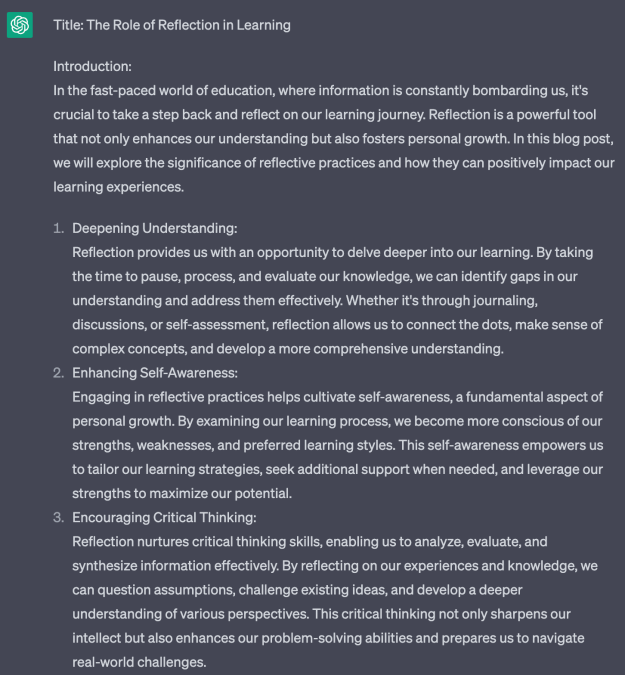
Would I ever just use Chat GPT to write my Daily Ink? No. But would I use it as a launching pad to help me generate ideas, or help me write a first draft? Absolutely. However, that’s just me. What you see above will be the kind of thing people who generate daily posts as part of a paid gig will do regularly. Sure they will make it sound a bit less formal, a bit more natural or conversational… but there are actually other Artificial Intelligences (yes plural, AI is not a single thing) which will do this and make it undetectable should you ask an AI detector if a human wrote it. Need something longer, like a school essay? Just ask Chat GPT to expand each of the 5 points into full paragraphs.

I didn’t iterate. I didn’t ask a more detailed question. I didn’t ask Chat GPT to further develop the ideas… If I did, it would make the above results even better and it would do so in a matter of seconds. And educators, try as you might, you can’t police it.

We are not far away from finding more AI written (or AI assisted) content on the internet than just purely human generated content… and we won’t know the difference.

— — — — — — — — — — — — — — — — — 

Update: (…I came back to this a few hours later.)

TLDR: The question isn’t how good is the AI tool, the question is, “How good are my prompts?”

I followed up and requested Chap GPT to, “Write the above blog post in a more conversational manner, using paragraphs without numbering or section titles.”
Here is the updated version:

The Role of Reflection in Learning

In the fast-paced world of education, where we’re constantly bombarded with information, it’s important to take a step back and reflect on our learning journey. Reflection is a powerful tool that not only enhances our understanding but also fosters personal growth. So, let’s dive into the significance of reflective practices and how they can positively impact our learning experiences.

When we engage in reflection, we go beyond surface-level learning. It provides us with an opportunity to delve deeper into our knowledge and identify any gaps in our understanding. By pausing, processing, and evaluating what we’ve learned, we can connect the dots and develop a more comprehensive understanding of the subject matter. Whether it’s through journaling, discussions, or self-assessment, reflection allows us to make sense of complex concepts and strengthen our grasp on the material.

But reflection goes beyond academic understanding. It also enhances our self-awareness, which is a crucial aspect of personal growth. By reflecting on our learning process, we become more conscious of our strengths, weaknesses, and preferred learning styles. This self-awareness empowers us to tailor our learning strategies, seek additional support when needed, and leverage our strengths to maximize our potential. It’s like having a roadmap that guides us towards effective learning.

Another great benefit of reflection is its ability to foster critical thinking skills. When we reflect, we engage in thoughtful analysis, evaluation, and synthesis of information. We question assumptions, challenge existing ideas, and gain a deeper understanding of various perspectives. This critical thinking not only sharpens our intellect but also enhances our problem-solving abilities. It equips us with the skills needed to tackle real-world challenges with confidence and creativity.

Reflection is also a catalyst for continuous improvement. Learning is a lifelong journey, and reflection plays a vital role in our growth. By reflecting on our successes and failures, we can identify areas for improvement and set meaningful goals. Regular self-reflection allows us to track our progress, celebrate achievements, and make necessary adjustments to our learning strategies. It promotes a growth mindset, inspiring us to embrace challenges, persist through obstacles, and strive for excellence.

In addition to all these benefits, reflection fosters metacognition, which is our ability to think about our own thinking. When we engage in metacognitive practices, such as reflecting on our learning process, monitoring our comprehension, and evaluating our strategies, we become more self-regulated learners. This metacognitive awareness empowers us to take control of our learning, adapt our approaches, and become more efficient and effective learners overall.

So, let’s make a conscious effort to pause, reflect, and embark on a transformative learning journey filled with growth, insight, and personal development. By embracing reflective practices, we deepen our understanding, foster self-awareness, sharpen critical thinking skills, promote continuous improvement, and cultivate metacognitive abilities. It’s time to unlock the true potential of our learning experiences through the power of reflection.

Then I followed up with, “Try again, still more conversational and less like an essay. Vary sentence and paragraph length, and end with a thought provoking question.”

I didn’t like what it came up with so I followed up one more time with, “This last version is a bit too conversational, try again and this time don’t start sentences with coordinating conjunctions like ‘But’ and ‘So’. Also change the first sentence so it less formal.”

Reflection in Learning: Unleashing the Power Within

In the whirlwind of education, where information bombards us from all directions, it’s easy to overlook the importance of reflection in our learning journey. We often rush from one lesson to the next, absorbing knowledge without truly digesting it. But what if we hit the pause button and took a moment to reflect?

Reflection goes beyond simply memorizing facts and figures. It’s a transformative process that allows us to delve deeper into our thoughts, experiences, and understanding of the subjects we encounter. It’s like shining a spotlight on our minds and examining everything we’ve absorbed in a more meaningful way.

What’s truly remarkable about reflection is that it extends beyond academia. It plays a crucial role in our personal growth as well. By engaging in reflection, we become more aware of our strengths, weaknesses, and unique learning styles. It’s like getting to know ourselves as learners on a whole new level. This self-awareness empowers us to tailor our learning strategies and leverage our strengths to maximize our potential.

Reflection isn’t a passive exercise; it’s an active one that fuels critical thinking. When we reflect, we question assumptions, evaluate information, and connect the dots. It enables us to go beyond the surface-level understanding and dive into the deeper layers of knowledge. This kind of thinking not only expands our intellectual capacity but also equips us with the skills to tackle real-world challenges with confidence and creativity.

Yet, the power of reflection doesn’t stop there. It serves as a catalyst for growth and continuous improvement. When we take the time to reflect on our learning journey, we identify areas where we can enhance our skills and knowledge. We set meaningful goals and work diligently towards them. It’s like having a personal roadmap for our own development, guiding us towards excellence and progress.

Intriguingly, reflection is also about metacognition – thinking about our own thinking. By engaging in metacognitive practices, such as reflecting on our learning process or evaluating our strategies, we become self-regulated learners. We take charge of our learning experience, adapt our approaches, and become more efficient and effective learners overall. It’s like having an internal compass that helps us navigate the vast landscape of knowledge.

So, let’s embrace the power of reflection. Let’s pause, process, and ponder on what we’ve learned. When we do, we unlock the true potential of our learning experiences. We deepen our understanding, foster self-awareness, sharpen critical thinking skills, and pave the way for continuous growth and personal transformation.

Have you taken a moment to reflect on your learning journey lately? What insights have you gained? How has reflection impacted your personal growth? Share your valuable thoughts and experiences in the comments below.

I think it would take one final personal edit, tweaking as I read it over once, and I’d have a pretty good blog post that’s both insightful and hard to identify as AI generated.

The question isn’t how good is the AI tool, the question is, “How good are my prompts?”

Major congestion

Yesterday I shared how malls are empty and said, “... all malls won’t die just the stand-alone ones. The newest form of densification in cities is to build a mall or commercial level shopping below high rises…

Today I’m stuck in Traffic on the 401, the busiest highway in North America, and I wonder how more densification will affect this? Will these new vertical communities encourage less commuting or will the sheer volume of people overwhelm our transportation infrastructure?

It will depend on developers. Will they develop so that the pulse of our cities is pedestrian? Or will we continue to live inside smaller and smaller condos and use our car as the majority of our outside our apartment experiences. I hope to see more outdoor spaces designed for pedestrians to travel and congregate, but real estate is money and most developers care more about profit than liveability, even though liveability is a huge selling point.

Other countries are building communities that don’t require commuting, how much longer will we be focused on cars and congestion instead of cafés and places for pedestrians to shop, eat, and congregate?

Empty Malls

We went to the mall nearest to my parent’s house and I was shocked to see about 60% of the stores closed. The grocery store and drug store were busy, but while my mom waited for a prescription I went looking for a coffee, and the rest of the mall was almost empty. The closest I got to finding coffee was a Subway and Booster Juice, both with no customers in the stores. Both had shuttered, empty sores next to them.

The strip mall and small malls that we’ve known for decades are dead. There won’t be a revival. Amazon, eBay, Etsy, and other online shopping sites are in direct competition with these malls and unless someone is pulled to these malls by the need for groceries or a prescription, none of the other few remaining stores will get a visit.

That said, all malls won’t die just the stand-alone ones. The newest form of densification in cities is to build a mall or commercial level shopping below high rises… stack the customers on top of the shopping spaces and make the mall convenient to visit. You don’t even need to put on a coat to visit the mall, it’s just a trip down the elevator, or a walk through an underground parking lot.

Goodbye strip mall. They will all be torn down and revived only when a few hundred condos are built above the mall space. You want customers in your mall? Make the mall an extension of their living space. Until that happens, you’ll see more and more empty, shut down, and abandoned stores… Malls that are mere shells of what they used to be.

Down the Social Media Rabbit Hole

I made a mistake last night. I was on Twitter and clicked on a video of a guy knocking down a surveillance camera on a street light in Australia. I then scrolled to the next video and went down a right wing rabbit hole. The first video was a voiceover of Tucker Carlson recently ‘dismissed’ from Fox News, and it was essentially trying to make humourous jokes about a transgender host taking over. Next was a Republican semi-automatic gun wearing black man praising the NRA and claiming the democrats are ‘coming for our guns’. Then came a Sean Hannity clip that I didn’t watch. Then came my first Canadian content with a clip bashing Justin Trudeau. And finally I called it quits after watching a geologist bashing climate change… in case you didn’t know, carbon dioxide is ‘plant food, not a pollutant’.

These crazy social media algorithms, and the deep fakes I spoke about a few days ago, are going to absolutely polarize us, paralyze us, and completely undermine us.

Don’t ignore opposing views, measure them. Don’t jump on the bandwagon, figure out if you want to travel the exact same route. Don’t criticize, question. Don’t SHOUT, disengage until cooler heads prevail.

Don’t pretend the algorithms aren’t already influencing you, be savvy and question why posts and videos are algorithmically chosen for you. You are either trying to be digitally literate or you are probably being manipulated and steered towards an extreme view.

From the horses mouth

I’ve already seen some really good deep fakes of famous people that both look and sound real. That was over a year ago and the technology is far better now. I just watched this NBC Nightly News clip on TikTok:

The whole video is cautionary and a little scary, looking at Artificial Intelligence (AI) as a possible threat to Humanity. At the 2:17 minute mark this was said,

“AI tools can already mimic voices, ace exams, create art, and diagnose diseases. And they are getting smarter every day.

In two years by the time of the election, human beings will not be able to tell the difference between what is real and what is fake.”

It occurred to me that the lead up to the next US election is going to include countless deep fakes that will be virally shared and reposted and re-shared, which will be far more convincing than anything we’ve seen so far. The clever ones won’t be far fetched in content, they will be convincing because they will subtly send people down a specific narrative without being outrageous or egregious and easy to spot. For example: Biden supporting and endorsing some ultra-left wing, ‘woke’ group the makes the right outraged. Or Trump speaking to a friend about how he hates guns and the NRA. Each of these can be completely fabricated and completely convincing.

This is really scary because where you get your news will be vitally important. Hopefully major news outlets would vet the videos and verify authenticity before sharing, but digital newspapers are always worried about missing the scoop and letting other networks go viral. Many less reputable sites will share the fake videos just because it fits their narrative. Other sites will knowingly share the fake videos because their intent is to mislead, and to feed anger and vitriol to their naive followers.

Conspiracies will be magnified and any mention of the videos being fake will be counter argued that reports of the video being faked are just the way the government is trying to keep the truth from you. The message being, the fakes are real and the reports of them being fake is the fake news. People already believe fake articles with no fact-checking, they are going to be completely fooled by extremely convincing fake videos.

My advice, find websites that you trust and make sure the web url is correct. Follow people you trust and question anything suspicious from them that isn’t from your trusted sites. If it’s not from your trusted site, if it’s not right from the horses mouth and it seems suspicious, consider it fake until you verify.

How serious is this? You don’t have to be famous to be deep faked. Here is a story of a mom thinking she was talking to her kidnapped daughter, convinced it was her voice on the phone with her kidnappers, but it was a fake and her daughter was upstairs in her room. The point of the video is to have a safe word with your family because anyone’s voice can be easily faked.

We are entering a time when people are defining truth differently, when fakes seem more like truth, and when sources of information are going to be as important as the information itself.