

Yesterday I asked Chat GPT for blog post ideas for a blog that discusses ‘education, learning, and general life lessons‘. This is what it responded with:

I then chose #4 and asked: Write a short blog post titled, “The Role of Reflection in Learning” on the topic of Exploring the significance of reflective practices in enhancing learning and personal growth.
This is what Chat GPT came up with:
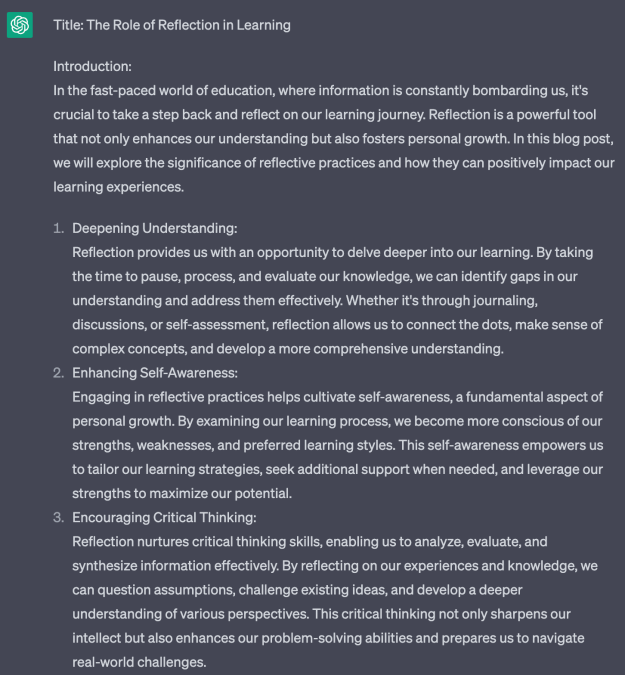

Would I ever just use Chat GPT to write my Daily Ink? No. But would I use it as a launching pad to help me generate ideas, or help me write a first draft? Absolutely. However, that’s just me. What you see above will be the kind of thing people who generate daily posts as part of a paid gig will do regularly. Sure they will make it sound a bit less formal, a bit more natural or conversational… but there are actually other Artificial Intelligences (yes plural, AI is not a single thing) which will do this and make it undetectable should you ask an AI detector if a human wrote it. Need something longer, like a school essay? Just ask Chat GPT to expand each of the 5 points into full paragraphs.
I didn’t iterate. I didn’t ask a more detailed question. I didn’t ask Chat GPT to further develop the ideas… If I did, it would make the above results even better and it would do so in a matter of seconds. And educators, try as you might, you can’t police it.
We are not far away from finding more AI written (or AI assisted) content on the internet than just purely human generated content… and we won’t know the difference.
— — — — — — — — — — — — — — — — —
Update: (…I came back to this a few hours later.)
TLDR: The question isn’t how good is the AI tool, the question is, “How good are my prompts?”
I followed up and requested Chap GPT to, “Write the above blog post in a more conversational manner, using paragraphs without numbering or section titles.”
Here is the updated version:
The Role of Reflection in Learning
In the fast-paced world of education, where we’re constantly bombarded with information, it’s important to take a step back and reflect on our learning journey. Reflection is a powerful tool that not only enhances our understanding but also fosters personal growth. So, let’s dive into the significance of reflective practices and how they can positively impact our learning experiences.
When we engage in reflection, we go beyond surface-level learning. It provides us with an opportunity to delve deeper into our knowledge and identify any gaps in our understanding. By pausing, processing, and evaluating what we’ve learned, we can connect the dots and develop a more comprehensive understanding of the subject matter. Whether it’s through journaling, discussions, or self-assessment, reflection allows us to make sense of complex concepts and strengthen our grasp on the material.
But reflection goes beyond academic understanding. It also enhances our self-awareness, which is a crucial aspect of personal growth. By reflecting on our learning process, we become more conscious of our strengths, weaknesses, and preferred learning styles. This self-awareness empowers us to tailor our learning strategies, seek additional support when needed, and leverage our strengths to maximize our potential. It’s like having a roadmap that guides us towards effective learning.
Another great benefit of reflection is its ability to foster critical thinking skills. When we reflect, we engage in thoughtful analysis, evaluation, and synthesis of information. We question assumptions, challenge existing ideas, and gain a deeper understanding of various perspectives. This critical thinking not only sharpens our intellect but also enhances our problem-solving abilities. It equips us with the skills needed to tackle real-world challenges with confidence and creativity.
Reflection is also a catalyst for continuous improvement. Learning is a lifelong journey, and reflection plays a vital role in our growth. By reflecting on our successes and failures, we can identify areas for improvement and set meaningful goals. Regular self-reflection allows us to track our progress, celebrate achievements, and make necessary adjustments to our learning strategies. It promotes a growth mindset, inspiring us to embrace challenges, persist through obstacles, and strive for excellence.
In addition to all these benefits, reflection fosters metacognition, which is our ability to think about our own thinking. When we engage in metacognitive practices, such as reflecting on our learning process, monitoring our comprehension, and evaluating our strategies, we become more self-regulated learners. This metacognitive awareness empowers us to take control of our learning, adapt our approaches, and become more efficient and effective learners overall.
So, let’s make a conscious effort to pause, reflect, and embark on a transformative learning journey filled with growth, insight, and personal development. By embracing reflective practices, we deepen our understanding, foster self-awareness, sharpen critical thinking skills, promote continuous improvement, and cultivate metacognitive abilities. It’s time to unlock the true potential of our learning experiences through the power of reflection.
Then I followed up with, “Try again, still more conversational and less like an essay. Vary sentence and paragraph length, and end with a thought provoking question.”
I didn’t like what it came up with so I followed up one more time with, “This last version is a bit too conversational, try again and this time don’t start sentences with coordinating conjunctions like ‘But’ and ‘So’. Also change the first sentence so it less formal.”
Reflection in Learning: Unleashing the Power Within
In the whirlwind of education, where information bombards us from all directions, it’s easy to overlook the importance of reflection in our learning journey. We often rush from one lesson to the next, absorbing knowledge without truly digesting it. But what if we hit the pause button and took a moment to reflect?
Reflection goes beyond simply memorizing facts and figures. It’s a transformative process that allows us to delve deeper into our thoughts, experiences, and understanding of the subjects we encounter. It’s like shining a spotlight on our minds and examining everything we’ve absorbed in a more meaningful way.
What’s truly remarkable about reflection is that it extends beyond academia. It plays a crucial role in our personal growth as well. By engaging in reflection, we become more aware of our strengths, weaknesses, and unique learning styles. It’s like getting to know ourselves as learners on a whole new level. This self-awareness empowers us to tailor our learning strategies and leverage our strengths to maximize our potential.
Reflection isn’t a passive exercise; it’s an active one that fuels critical thinking. When we reflect, we question assumptions, evaluate information, and connect the dots. It enables us to go beyond the surface-level understanding and dive into the deeper layers of knowledge. This kind of thinking not only expands our intellectual capacity but also equips us with the skills to tackle real-world challenges with confidence and creativity.
Yet, the power of reflection doesn’t stop there. It serves as a catalyst for growth and continuous improvement. When we take the time to reflect on our learning journey, we identify areas where we can enhance our skills and knowledge. We set meaningful goals and work diligently towards them. It’s like having a personal roadmap for our own development, guiding us towards excellence and progress.
Intriguingly, reflection is also about metacognition – thinking about our own thinking. By engaging in metacognitive practices, such as reflecting on our learning process or evaluating our strategies, we become self-regulated learners. We take charge of our learning experience, adapt our approaches, and become more efficient and effective learners overall. It’s like having an internal compass that helps us navigate the vast landscape of knowledge.
So, let’s embrace the power of reflection. Let’s pause, process, and ponder on what we’ve learned. When we do, we unlock the true potential of our learning experiences. We deepen our understanding, foster self-awareness, sharpen critical thinking skills, and pave the way for continuous growth and personal transformation.
Have you taken a moment to reflect on your learning journey lately? What insights have you gained? How has reflection impacted your personal growth? Share your valuable thoughts and experiences in the comments below.
I think it would take one final personal edit, tweaking as I read it over once, and I’d have a pretty good blog post that’s both insightful and hard to identify as AI generated.
The question isn’t how good is the AI tool, the question is, “How good are my prompts?”